Data tables
This page is part of our section on Persistent storage & databases which covers where to effectively store and manage the data manipulated by Windmill. Check that page for more options on data storage.
Windmill Data Tables let you store and query relational data with near-zero setup using databases managed automatically by Windmill. They provide a simple, safe, workspace-scoped way to leverage SQL inside your workflows without exposing credentials. Data tables can also be used from full-code apps via SQL backend runnables and from the Database Studio app component for browsing and editing data visually.
Data tables are queryable as a typed schema from TypeScript, Python and DuckDB clients, and can be browsed, edited and used as a Postgres trigger source without ever exposing the underlying connection string to users.
Getting started
Go to workspace settings -> Data Tables and configure a Data Table :
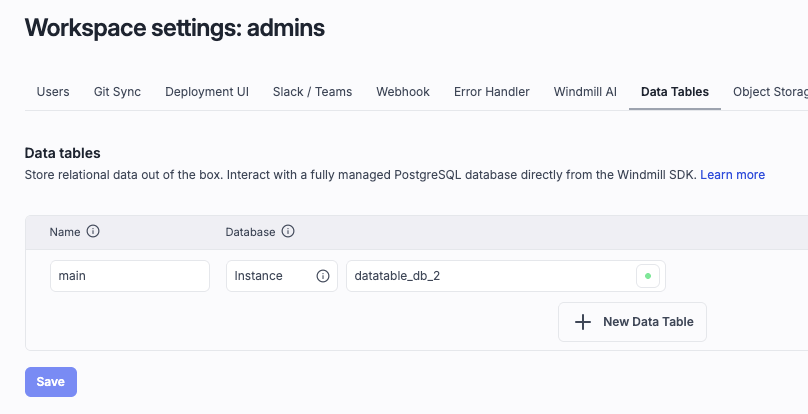
Superadmins can use a Custom instance database and get started with no setup.
Usage
- Typescript
- Python
- DuckDB
import * as wmill from 'windmill-client';

export async function main(user_id: string) {
	// let sql = wmill.datatable('named_datatable');
	let sql = wmill.datatable();

	// This string interpolation syntax is safe
	// and is transformed into a parameterized query
	let friend = await sql`SELECT * FROM friend WHERE id = ${user_id}`.fetchOne();
	// let allFriends = await sql`INSERT INTO friend VALUES ('John', 21)`.fetch();

	return friend;
}
import wmill

def main(user_id: str):
    # db = wmill.datatable('named_datatable')
    db = wmill.datatable()

    # Postgres scripts use positional arguments
    friend = db.query('SELECT * FROM friend WHERE id = $1', user_id).fetch_one()
    # all_friends = db.query('SELECT * FROM friend').fetch()

    return friend
-- $user_id (bigint)

-- ATTACH 'datatable://named_datatable' AS dt;
ATTACH 'datatable' AS dt;
USE dt;

SELECT * FROM friend WHERE id = $user_id;
In workspace settings, we recommend configuring a single primary data table (and at most a few secondary ones), and using schemas to organize your data. This is not about the number of SQL tables inside a data table, which is unlimited. There is no hard limit either way.
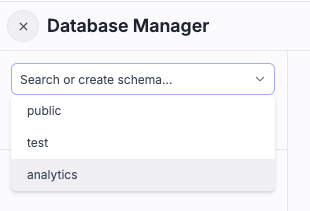
You can reference schemas normally with the schema.table syntax, or set the default search path with this syntax (Python / Typescript) :
sql = wmill.datatable(':myschema'); // or 'named_datatable:myschema'
sql`SELECT * FROM mytable`; // refers to myschema.mytable
Query methods
Every sql`...`, sql.query(...) or db.query(...) call returns a statement object with four execution methods:
fetch()— all rows from the last statement (default)fetchOne()/fetch_one()— first row only, ornull/Noneif emptyfetchOneScalar()/fetch_one_scalar()— first column of the first rowexecute()— run the query and return nothing
For multi-statement queries or scalar-only results, pass a result collection mode to fetch:
- Typescript
- Python
await sql`...`.fetch({ resultCollection: 'all_statements_all_rows' });
db.query('...').fetch(result_collection='all_statements_all_rows')
Available modes: last_statement_all_rows (default), last_statement_first_row, last_statement_all_rows_scalar, last_statement_first_row_scalar, all_statements_all_rows, all_statements_first_row, all_statements_all_rows_scalar, all_statements_first_row_scalar.
TypeScript also supports sql.query(sql, ...params) as an alternative to tagged-template syntax, matching the Python API:
await sql.query('SELECT * FROM friend WHERE id = $1', user_id).fetchOne();
Schemas
Data tables support Postgres schemas to organize tables into logical groupings within a single data table. You can:
- Create, rename and drop schemas from the workspace settings Data Tables UI.
- Reference tables with the explicit
schema.tablesyntax, or switch the default search path from the client by appending:myschemaafter the data table name (wmill.datatable('named_datatable:myschema')orwmill.datatable(':myschema')for the default data table). - Use schemas as an organizational boundary without needing multiple configured data tables: we recommend one primary data table (and at most a few secondary ones) per workspace, with schemas for separation.
Type-checked queries
The Windmill editor understands your data table's schema and type-checks queries at edit time for TypeScript, Python and DuckDB scripts. The introspected schema (tables, columns, types) is surfaced in the editor's SQL IntelliSense, and invalid columns or type mismatches are flagged before the script ever runs.
String-interpolated parameters (e.g. sql`SELECT * FROM friend WHERE id = ${user_id}`) are always transformed into safe parameterized queries, so type checking covers both the SQL itself and the bindings.
sql.raw for dynamic SQL fragments
Use sql.raw(value) to inline a string directly into the SQL query without parameterization. This is useful for dynamic table or column names that cannot be bound as parameters:
const sql = wmill.datatable();
await sql`SELECT * FROM ${sql.raw(table)} WHERE age > ${age}`.fetch();
// Produces: SELECT * FROM users WHERE age > $1::BIGINT
sql.raw is available on both wmill.datatable() and wmill.ducklake(). Since the value is inlined verbatim, ensure it comes from trusted input to avoid SQL injection.
When a data table schema changes, the editor re-introspects it so downstream scripts immediately see the new columns and types without a manual refresh.
Assets integration
Data tables are assets in Windmill. When you reference a data table in a script, Windmill automatically parses the code and detects them. You can then click on it and explore the data table in the Database Explorer.
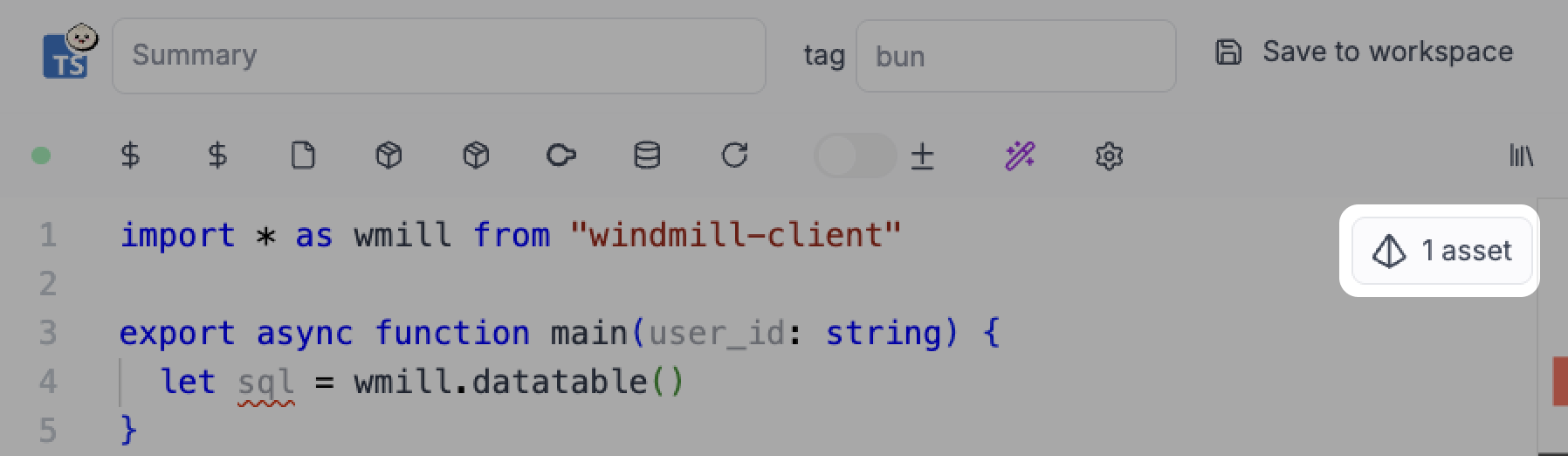
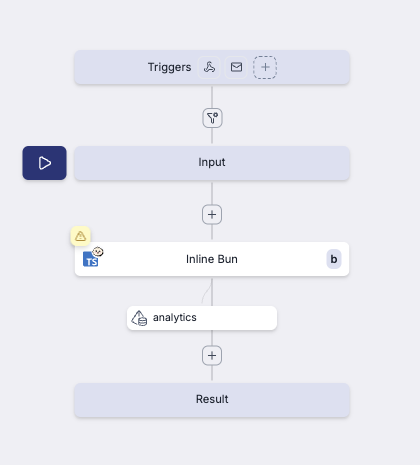
Windmill auto detects if the data table was used in Read (SELECT ... FROM) or Write mode (UPDATE, DELETE ...). Assets are displayed as asset nodes in flows, making it easy to visualize data dependencies between scripts.
Database Studio integration
Data tables are a first-class source in the Database Studio component of the low-code app editor (legacy). Select Data Table as the component's Type, then use the built-in table picker to choose from the workspace's configured data tables — no resource wiring required.
From there you get the full Database Studio experience (browse rows, inline edit, create/alter tables, schema explorer) on top of your data tables, without exposing the underlying credentials to the app builder or end users.
Use as a Postgres resource and trigger source
A data table that is backed by a Postgres resource (either the custom instance database or a workspace-managed Postgres resource) can be used anywhere a Postgres resource is expected — most notably as the source of a Postgres trigger. This lets you react to inserts, updates and deletes on tables managed by a data table without handing out the Postgres credentials.
Workspace-scoped
Data tables are scoped to a workspace. All members of the workspace can access its data tables. Credentials are managed internally by Windmill and are never exposed to users.
Special data table: main
The data table named main is the default data table. Scripts can access it without specifying its name.
Example:
# Uses the 'main' data table implicitly
wmill.datatable()
Migrations
You can version a data table's schema with SQL migrations. A migration is a pair of SQL statements - an up migration that applies a change (for example CREATE TABLE) and an optional down migration that reverts it. Applied migrations are tracked in a _wm_migrations table inside each data table, so a migration is never applied twice, and migrations run in timestamp order.
Each migration runs as a normal user-permissioned Windmill postgresql job (labelled datatable_migration), so applications and rollbacks show up in the runs history and failures surface the underlying Postgres error.
From the UI
Go to workspace settings -> Data Tables and click Migrations next to a data table to open the migrations modal. From there you can:
- Create a New migration with
Up/DownSQL editors, and optionally Create and run it in one step (the insert is reverted if the run fails). - Run or Revert an individual migration, or Run all pending migrations. A status dot shows whether each migration has been applied (green), is not yet applied (orange), or has an unknown state (grey).
- Generate initial migration, which snapshots the data table's current schema into a first migration and marks it as already applied (with no
down), so it is never re-run. This is useful to bring an existing data table under migration control.
Running or reverting a migration out of order (one that has earlier un-run migrations, or later applied ones) asks for confirmation first, and deletions always confirm.
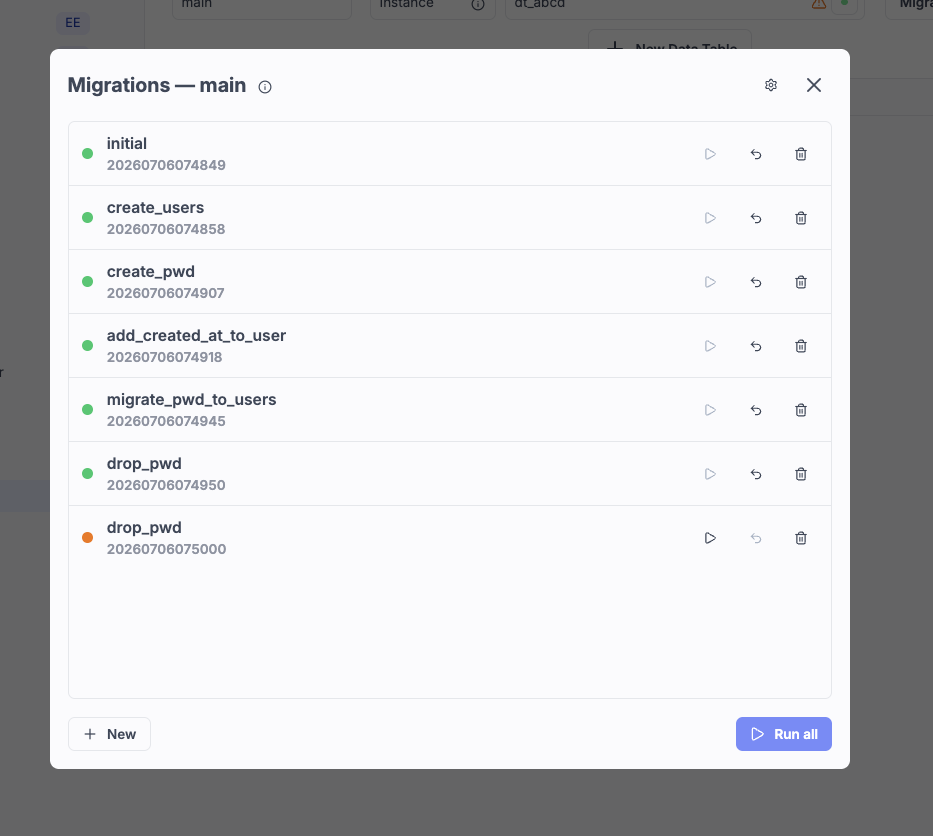
From the CLI
Migrations are stored as workspace files under migrations/datatable/<datatable>/ and can be scaffolded, applied and rolled back with the wmill datatable migrate commands:
wmill datatable migrate new add_users_table   # scaffold .up.sql / .down.sql files
wmill datatable migrate up                     # apply all pending migrations
wmill datatable migrate down                   # roll back the most recent migration
See the CLI datatable reference for the full command reference and sync behavior. If the workspace has git sync enabled, migrations are committed to the linked repository as they are created, edited or deleted.
Database types
Windmill currently supports two backend database types for Data Tables:
1. Custom instance database
- Uses the Windmill instance database.
- Zero-setup, one-click provisioning.
- Requires superadmin to configure.
- Although the database exists at the instance level, it is only accessible to workspaces that define a data table pointing to it.
- See Custom instance database for more details.
2. Postgres resource
- Attach a workspace Postgres resource to the data table.
- Ideal when you want full control over database hosting, but still benefit from Windmill's credential management and workspace scoping.
Permissions
Currently, Windmill does not enforce database-level permissions in data tables.
- Any workspace member can execute full CRUD operations.
- Table/row-level permissions may be introduced in a later version.
Windmill ensures secure access by handling database credentials internally.
Use on agent workers
wmill.datatable() and wmill.ducklake() work on agent workers out of the box, from both TypeScript and Python. Because agent workers do not run the embedded internal Windmill server, the clients automatically detect the execution environment and fall back from the inline preview path to a run-and-wait flow against the main Windmill API, so scripts that use data tables remain portable between regular and agent workers with no code changes.